
Description
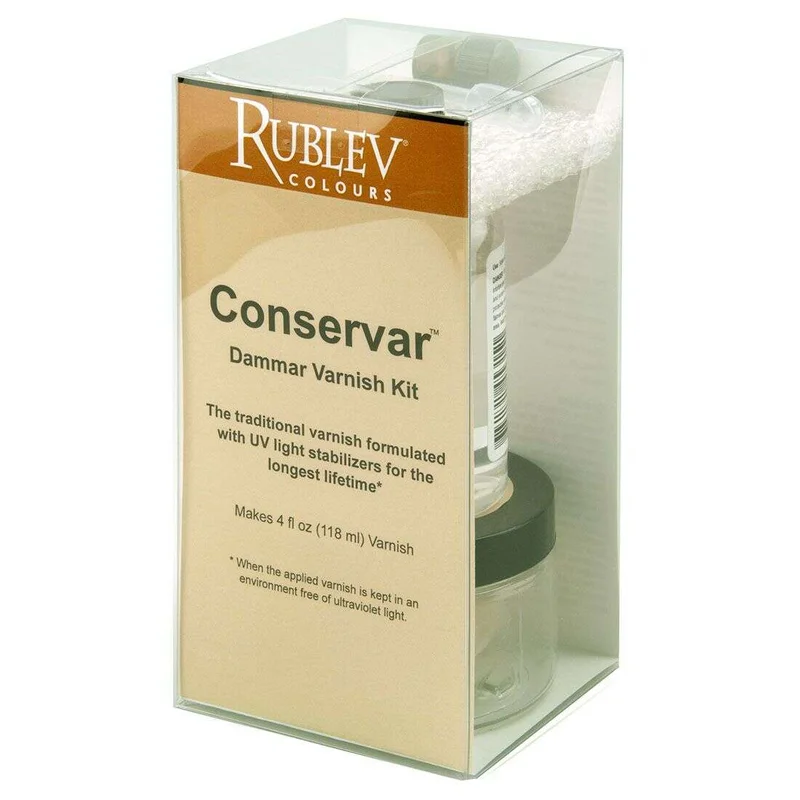
Conservar Dammar Varnish Kit allows you to make varnish fresh to use when needed. The kit contains the following items:
• Dammar Solvent
• Dammar (varnish resin)
• UV Stabilizer
• Mixing jar
• Pipette
Conservar Dammar Varnish is made from the best grade of natural dammar resin dissolved in aromatic and aliphatic solvents with UV light stabilizer. Conservar will not oxidize or yellow for 50 years if protected from UV light as shown by accelerated aging tests conducted at the National Gallery, Washington, D.C.* Conservar achieves optimum wetting of the paint surface to enhance and bring out colors, has minimum solvent action on paint, and maximum resin content for best coverage. It dries to a film that levels well and can be rubbed when dry for less gloss.
Dammar is the most common varnish since the 19th century and gives a very high gloss. Rublev Colours offers this natural resin in several varnish formulations, such as the traditional five-pound cut in turpentine (Neil’s Best Dammar Varnish) and as a traditional picture varnish (Dammar Picture Varnish) in petroleum solvents. However, the best form of dammar as a picture varnish is Conservar Dammar Finishing Varnish. While dammar is a popular varnish, stronger and more polar solvents will be needed to remove it as time passes.
* Rie, E.R. de la and McGlinchey, C.W. 1990. A hindered amine light stabilizer affects the aging of dammar and mastic varnish in an environment free of ultraviolet light. In Cleaning, retouching and coatings: Technology and practice for easel paintings and polychrome sculpture. Preprints of the contributions to the Brussels Congress, 3–7 September 1990. J.S. Mills and P. Smith, eds. London: International Institute for Conservation of Historic and Artistic Works:160–4.
Recommended Uses
Conservar Dammar Varnish is recommended as a final varnish on the following paint films:
- Alkyd
- Oil
Varnishes do not work well with casein, distemper, egg tempera, gouache, watercolor, and drawings because they absorb the paint and/or paper and become an integral part of the picture, which could cause discoloration. In addition, varnishes on works created using these materials cannot be removed.
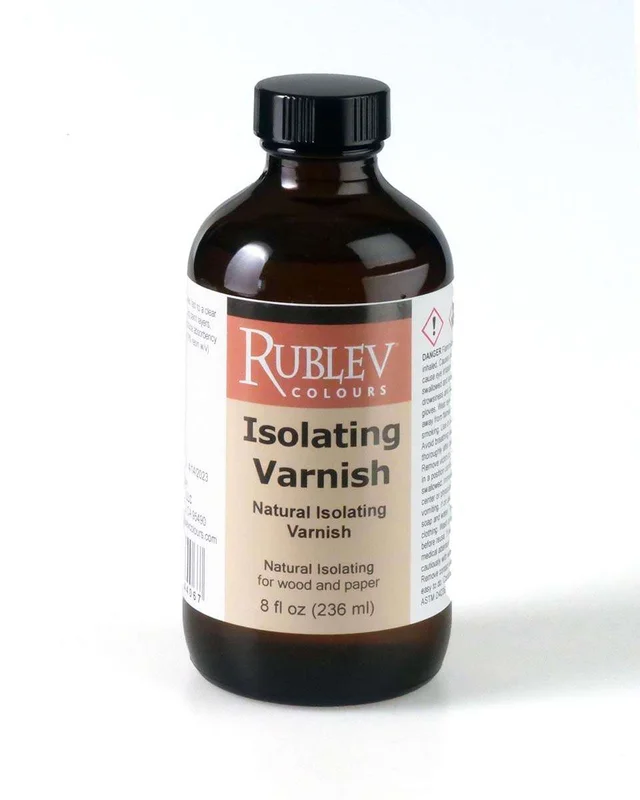
To varnish casein, distemper, egg tempera, gouache, watercolor, and drawings, apply an isolating coating to the painting or drawing, then apply a final picture varnish, such as Conservar Finishing Varnish. This way, the final varnish can be removed without damaging the painting or drawing underneath. Remember that any isolating coating becomes a permanent part of the artwork since the paint layer absorbs it.
Coverage
Makes approximately four fluid ounces (118 ml), which covers approximately 80 square feet (7.4 square meters).
Directions
Before actual use, it is essential to test Conservar varnishes on test pieces to understand how they perform and alter the surface appearance of your paintings. For best results, apply to a test piece similar in composition to the artwork to be varnished. This will help ensure that a successful varnish application will be achieved.
How to Prepare
Remove all items from the package. Pour solvent into the jar with varnish resin. Close the jar tightly, shake it, and allow it to stand until completely dissolved (usually one to two days). Once dissolved and no remaining resin particles are visible in the jar, fill the pipette with solvent from the jar and release it into the small amber vial containing the UV stabilizer. Close the vial and shake until thoroughly mixed. Pour the solvent and stabilizer mixture into the jar. If the vial is not empty, draw any remaining liquid into the pipette and release it into the jar. Stir the contents of the jar well, and the varnish is ready to use. Best used within 30 days of combining ingredients.
When to Varnish
Wait 6 to 12 months for most paintings before varnishing with Conservar Dammar Varnish.
Preparation for Varnishing
Acclimate your painting and varnish materials and tools to the same environment. At least several hours before varnishing, place all items, such as your painting, brushes, containers, and Conservar varnish, in the same room. Varnish in a dust-free environment with the least amount of air movement to avoid raising dust.
It is best to brush or spray apply Conservar varnishes. Other methods, such as using paint pads, sponging, or rolling, are not recommended, as they may result in foaming, loss of film clarity, non-uniform coverage, excessive film buildup, sagging, or deposits of materials from the application tool.
Brush Application
Apply with a wide, flat, soft-hair brush. Conservar Dammar Varnish can be thinned up to 20% with turpentine. DO NOT MIX WITH WATER. Apply a second coat if necessary to even out the painting’s sheen. Allow the varnish to dry for three days, then wipe the varnished surface with a soft, lint-free cloth.
Spray Application
Spraying is the best way to achieve an even varnish coating, particularly for impasto surfaces. It is also a valuable technique for creating a matte surface. The size of the surface to be sprayed will determine the best type of spray equipment to use. Conservar varnishes can be sprayed from an airbrush, airless or air-pressure spray equipment, or refillable aerosol spray can.
To prepare for spraying, make sure all equipment is free of dirt. Work in an area free of dust and dirt, and keep work off the ground when spraying. Spray two to four light, even coats instead of one or two thicker applications, allowing enough time for drying between coats (1 to 4 hours or until the surface is tack-free).
Release the spray trigger when stopping the sprayer’s motion during application to avoid a varnish buildup in one spot. Maintain a uniform distance from the surface and avoid spraying in an arcing motion. Make straight passes across the work, changing direction once the spray has cleared the edge of the piece being varnished. Slightly overlap the spray pattern with each pass until the entire passage has been covered.
To achieve a more uniform spray application, turn the painting 90 degrees and apply the subsequent coat perpendicular to the previous one. A typical spray application lays down a film only 1/8 to 1/4 the thickness of a brush coat application. If maximum protection is required of the varnish layer, apply multiple coats.
Drying Time
When applying multiple coats (spray application only), allow 1 to 4 hours between coats. Inspect the surface for tackiness, which may mean the coat is not sufficiently dry. Let the varnish cure for several days before packing or transporting the painting. Avoid contacting the surface with packing materials, including glassine, bubble wrap, or any other plastic, during transportation and storage. NEVER STACK PAINTINGS, whether varnished or not.
Care and Storage
Conservar varnishes are removable, so it is important not to paint them over. Paint applied over the varnish would also be potentially removable and would pose a difficult problem in conservation or restoration attempts.
Techniques for Reducing Gloss
There are several different ways to reduce the gloss of Conservar varnish:
- Dilute the varnish with additional solvent before using.
- Apply a thin coating. The thinner the coating, the lower the gloss.
- Brush the varnish as it dries. When the varnish starts to set up, continuing to brush will microscopically roughen the surface, making it less glossy.
- Spray apply the varnish.
If the varnished surface of your painting appears too glossy, you can apply a final coating of Conservar Wax. Rub on a thin layer of wax with a soft, lint-free cloth using small circular strokes. Allow the wax to dry overnight for the highest degree of matte. To create a satin finish, let the wax dry for 4 to 6 hours, then gently buff.
Cleanup
Clean all equipment immediately following application. Clean brushes with turpentine. Always make a test piece for your application and surface to ensure desired results.
Removal
Use a clean, soft, lint-free rag dampened with turpentine. Gently wipe the varnished surface, repeating the process until all varnish is removed. Do not use stronger solvents. Allow the surface to dry, then reapply Conservar varnish.
Conservar is a trademark of Natural Pigments. Rublev Colours is a registered trademark of Natural Pigments.
Reviews
There are no reviews yet.